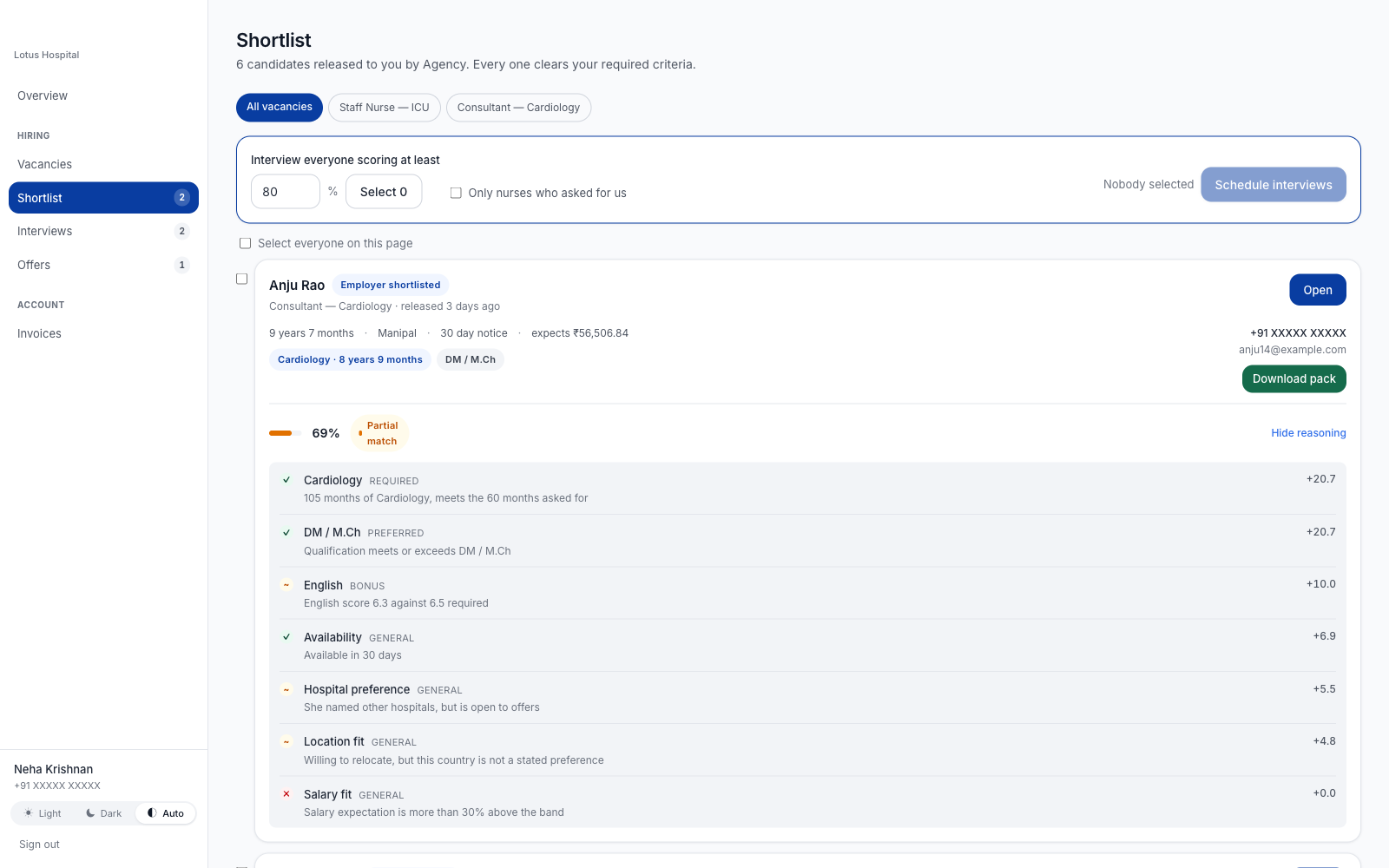
Most matching software shows a number: 87%. The recruiter looks at it and asks, “87% of what?” Nobody can answer, so nobody trusts it. When we built a hiring platform for a healthcare recruitment agency, we set one rule: a score without a reason does not ship.
Match ids, not words
If a job says “ICU” and a CV says “Intensive Care”, a text search misses the match. So candidates and jobs point at the same list of professions, specialties and skills, and each item carries synonyms. Matching becomes comparing ids, not guessing at words.
Make every requirement a row
Each requirement on a job is a row with four things: what it is, which item it points to, how much it matters (required, preferred or bonus), and a weight. That one table drives everything else.
Two steps: filter, then score
- Filter. Anyone who misses a required item is out: not a weak match, not a match at all. We keep every reason they failed, not just the first, because the most common question is “why is this list empty?”.
- Score. Everyone left gets a score. Each requirement adds a part between 0 and 1, and each part comes with a written reason. The reasons are stored with the match.
The employer then sees something like this:
87% — 5 years of ICU ✓, ventilator at 5/5 ✓, licence verified with 847 days validity ✓, would need to relocate ✗
Show what each requirement costs
The job wizard counts matching candidates live as requirements change. In our demo data:
| Requirements | Candidates |
|---|---|
| Nurses, no requirements | 164 |
| + ICU required | 19 |
| + three years of ICU | 10 |
| + ECMO required | 4 |
| ECMO relaxed to preferred | 10 |
That one screen teaches an employer more about their job than any report. ECMO as “required” leaves 4 people. As “preferred”, it leaves 10.
Keep a person in the loop
The system suggests and a person decides. Agency staff review every shortlist before an employer sees it. The reasons make that review fast, because staff can see why each person is on the list.
The lesson
Explainable matching is not a bigger algorithm. It is a shared list of skills, requirements stored as data, two clear steps, and reasons you can read. If your software scores people, products or leads, the same rules apply, and our software team can help.